Beyond Ring Strain: Deciphering the Role of Ligand Structure in Pd-Olefin Cooperative Catalysis
Abstract
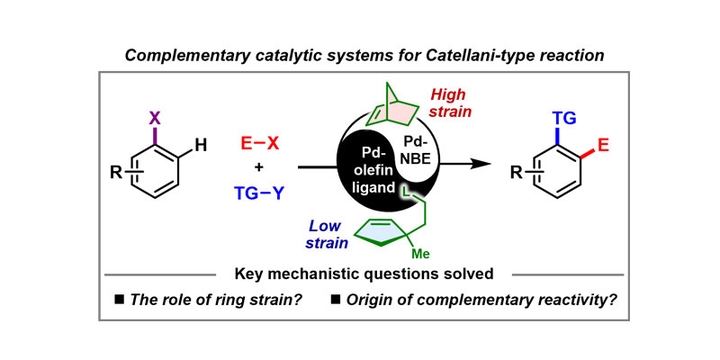
Ring strain is a pervasive driving force in organic chemistry, enabling unique reaction pathways through the release of stored potential energy. Within the realm of palladium-norbornene cooperative catalysis (the Catellani reaction), norbornene (NBE) has long been regarded as an irreplaceable mediator, with its high ring strain considered indispensable for the catalytic cycle. In 2022, we reported a novel class of low-strained cooperative olefin ligands that challenge this structural paradigm. This system enables synthetically viable transformations inaccessible to traditional Pd-NBE catalysis, establishing itself as a robust complementary approach within the broader Catellani-type reaction regime of Pd-olefin catalysis. Herein, through a combined experimental and computational approach, we conducted a systematic comparative mechanistic study on representative Pd-NBE and Pd-olefin ligand systems. This work elucidates the role of ring strain in these reactions and identifies the critical factors governing the observed complementary reactivity. We demonstrate that ring strain is not a mandatory requirement for Catellani-type reactivity, and side-arm coordination is the key factor governing the divergent reactivity between Pd-NBE and Pd-olefin ligand systems. This work not only clarifies important mechanistic questions in Pd-olefin cooperative catalysis but also provides guiding principles for the future design of novel cooperative mediators and ligands.

Yu-Xiu Li
PhD student, 2021–2026
The greatest test of courage on earth is to bear defeat without losing heart.

Yu Meng
Graduate, class of 2026
